

Your organisation has backups, firewalls, security policies and incident response procedures in place. But can it demonstrate that everything works as intended?
This is undoubtedly a question that deserves your attention, particularly when assessing your organisation’s readiness for NIS2 compliance.
Many organisations have already invested in cybersecurity tools and measures. However, without a clear understanding of their effectiveness, security risks may remain unaddressed and regulatory requirements may still go unmet.
This is precisely where a NIS2 readiness assessment comes in.
Through a structured assessment, organisations can evaluate their existing measures against applicable requirements, identify security gaps and determine where to focus their next efforts.
But how should this assessment be carried out? And which vulnerabilities might still be going unnoticed?
A NIS2 readiness assessment begins with understanding the organisation’s current situation, including the systems it relies on, the risks it faces and the security measures already in place.
The article 21 of the NIS2 Directive sets out a range of cybersecurity risk-management areas, including incident handling, business continuity, supply chain security, access control, and the assessment of the effectiveness of implemented measures.
These areas provide an important framework for identifying potential weaknesses, commonly referred to as gaps.
To achieve this, organisations can conduct a gap analysis, helps you assess your existing security measures against applicable NIS2 requirements, identify weaknesses and prioritise improvements.
However, there is one important distinction. Having a security measure in place does not necessarily mean it is effective.
An organisation may perform daily backups but never have tested whether it can restore its systems within the time required to maintain business operations.
This is precisely the type of gap that a NIS2 readiness assessment should uncover.
To deliver meaningful results, a NIS2 readiness assessment should follow a structured methodology supported by concrete evidence.
The process can be organised into four key steps:
1. Identify the applicable requirements
Confirm the organisation’s regulatory scope and determine which cybersecurity obligations apply, taking into account the relevant national legislation.
2. Review existing security measures
Assess the policies, procedures and security controls already in place, from access management to incident response.
3. Gather Evidence
Verify whether the measures are effectively implemented and operating as intended. Monitoring logs, test reports, security configurations and internal documentation can help demonstrate both their implementation and effectiveness.
4. Document the Identified Gaps
Record any requirements that have not yet been met, the weaknesses identified and the associated risks.
This assessment provides a clearer picture of the organisation’s NIS2 readiness and helps inform the next steps.
Not all cybersecurity weaknesses are immediately visible. Some exist within processes that appear to be working correctly but whose effectiveness has never been properly tested.
Consider these three examples:
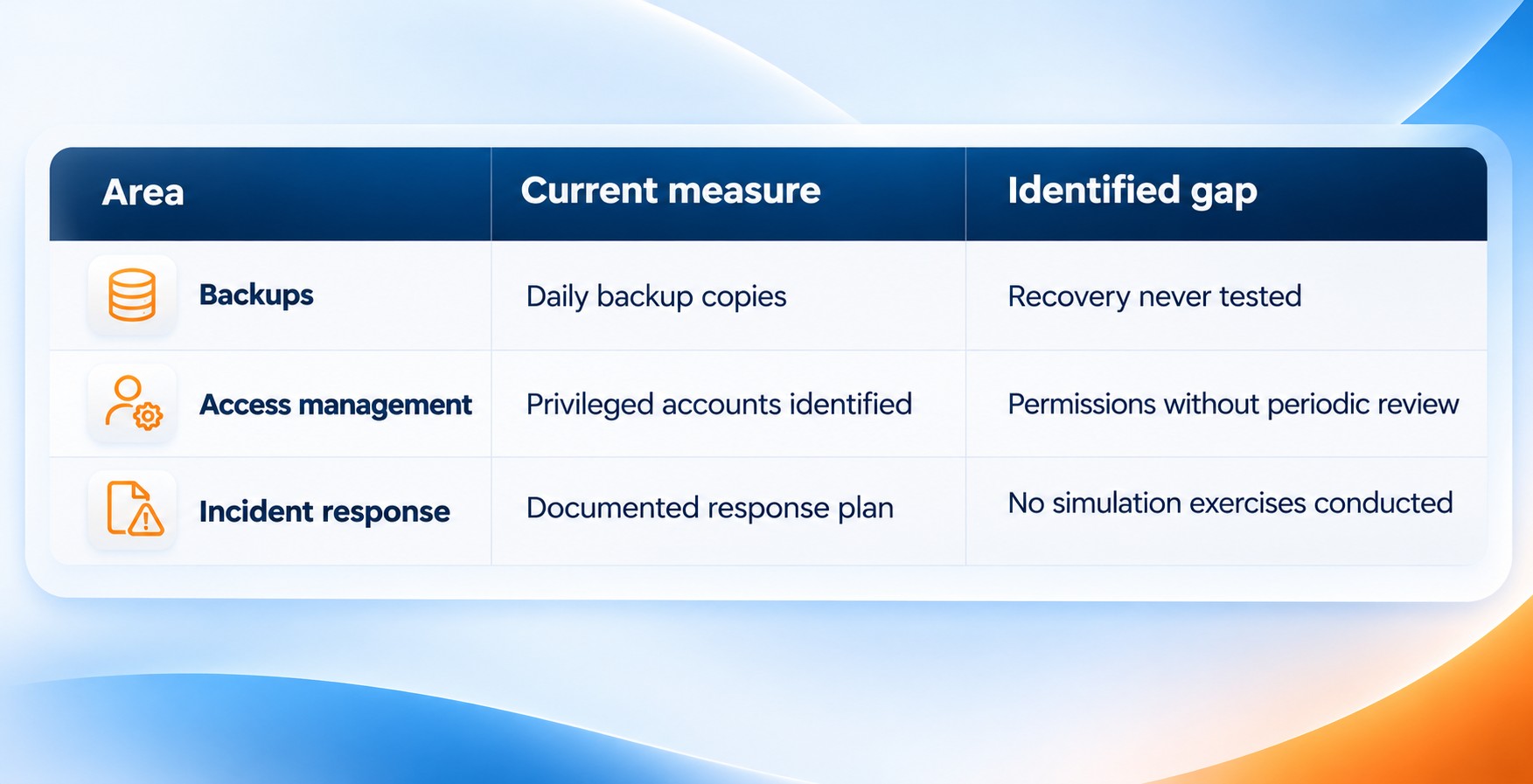
These examples demonstrate how an organisation can have security measures in place and still remain exposed to significant risks.
This is why a NIS2 readiness assessment should focus on gathering evidence that security measures are effective and aligned with operational needs.
Once the assessment is complete, an equally important question arises: which gaps should be addressed first?
Not all gaps pose the same level of risk. A vulnerability affecting a critical system may require more urgent action than a weakness with limited operational impact.
The assessment findings should therefore be translated into an action plan that defines priorities, assigns responsibilities, allocates resources and establishes implementation timelines.
This plan should also include monitoring mechanisms to verify that corrective actions have been implemented and that the identified risks have been effectively reduced.
The goal is to ensure that the assessment leads to tangible improvements in the organisation’s ability to prevent, detect, respond to and recover from cybersecurity incidents.
Preparing for NIS2 starts with understanding existing risks and identifying the security measures that still need to be strengthened.
At ORBCOM, we help organisations assess their IT infrastructure, identify vulnerabilities and implement cybersecurity measures tailored to their specific needs.
But before deciding where to invest, it is essential to understand what actually needs to be addressed.
To help you take this first step, we have developed our NIS2 Self-Assessment Guide: Where to Start Your Assessment,providing practical guidance on reviewing existing security measures, identifying gaps and setting priorities.

Uma empresa está mais preparada para implementar inteligência artificial quando os seus sistemas comunicam entre si, os dados estão organizados e protegidos, a infraestrutura consegue suportar novas exigências e existe uma responsabilidade clara pela integração da IA. Antes de escolher uma ferramenta, é importante avaliar estes quatro elementos.
Antes de investir em IA, uma empresa deve avaliar quatro áreas principais: integração dos sistemas, localização e segurança dos dados, capacidade da infraestrutura e responsabilidade pela integração. A tecnologia de IA pode ser poderosa, mas o seu valor depende da capacidade da empresa para lhe disponibilizar dados, sistemas e infraestrutura adequados.
A infraestrutura deve conseguir suportar maior processamento de dados, tráfego e exigência sobre a cloud e a rede. Antes de implementar IA, a empresa deve avaliar se a infraestrutura atual consegue acompanhar estas necessidades. Caso contrário, a implementação pode tornar-se lenta, instável ou mais dispendiosa do que o previsto.
O primeiro passo é garantir que os sistemas comunicam entre si e que os dados necessários estão acessíveis de forma estruturada e segura. CRM, ERP, sistemas operacionais e outras fontes de informação não devem funcionar como silos. Também é essencial definir quem pode aceder aos dados e como esses acessos são controlados.
Os principais riscos incluem sistemas que não comunicam entre si, acesso inadequado a dados, infraestrutura insuficiente e falta de responsabilidade clara pela integração. A IA pode também aumentar a superfície de acesso à informação da empresa. Por isso, segurança, gestão de acessos e integração devem ser consideradas antes da implementação, e não apenas depois.
Sign up to our newsletter and keep up with the latest insights.
If you would like to get to know ORBCOM better and understand how our products, consulting services and outsourcing, fit your reality, speak to a specialist.