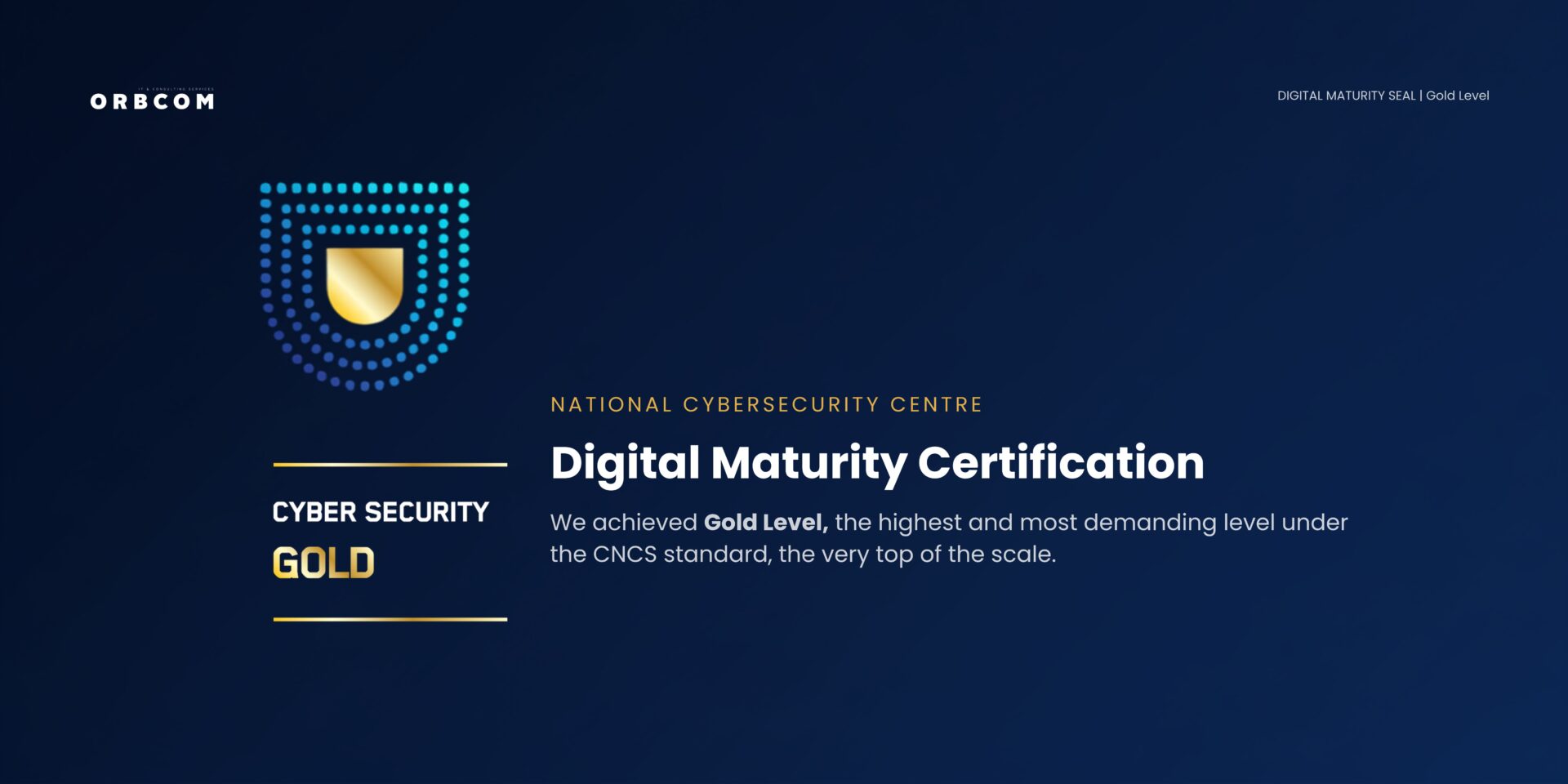
Choosing a technology partner is ultimately an investment in trust. Businesses need to be confident that internal processes are robust, information security is taken seriously, and the commitments made during commercial discussions are reflected in day-to-day operations. However, trust alone is difficult to verify without an independent third party assessing and validating the company’s claims. That is precisely the purpose of the Digital Maturity Certification..
Orbcom was assessed and achieved Gold Level certification. The highest level on the scale, awarded to just 13 companies this year.
Digital Maturity Certification is an independent assessment process that measures an organisation’s level of maturity across critical areas of digital transformation, with a particular focus on cybersecurity, risk management and the strength of internal processes.
The certification is based on an audit that reviews concrete evidence, including security policies, risk management procedures, incident response practices and the organisation’s overall maturity in protecting data and IT systems.
In practice, it represents the difference between a company simply saying, “we are secure,” and providing an independently validated document that proves it, based on transparent criteria that can be audited by any interested party.
This type of certification is becoming increasingly important in Portugal because the risks associated with cybersecurity failures are no longer viewed solely as technical issues. They are now recognised as business risks.
Service disruption, customer data loss, contractual exposure and other consequences carry a direct financial cost. As a result, more companies and public-sector organisations are requiring evidence of digital maturity before entering into a contract.
The Digital Maturity Certification framework is divided into three levels, in ascending order of requirements:
Each step up significantly reduces the number of organisations that achieve certification. This year, only 13 companies reached Gold Level.
This is by no means a figure chosen to sound impressive. It is the direct result of rigorous assessment criteria that leave no room for generic answers or processes that exist only on paper.
For Orbcom, achieving Gold Level was not an end goal in itself. It was independent confirmation of work that had already been carried out internally for several years across areas such as cybersecurity, cloud services and data infrastructure,all of which are part of the company’s service portfolio..
Certification does not create maturity. It recognises it.
Orbcom’s Gold-Level Digital Maturity Certification can be publicly viewed and verified here: Certified Organisations.
The case of unauthorised access to SNS user data demonstrates the importance of controlling credentials, permissions and access in organisations that manage sensitive information. A compromised credential can enable improper access to critical data, especially when there is no adequate monitoring or visibility over who is consulting the information.
Compromised credentials can allow apparently legitimate access to internal systems, exposing personal data, health information, internal processes and essential services. This type of access is often difficult to detect immediately, increasing the potential impact of a security incident.
The cybersecurity directly affects service continuity, the protection of citizens’ data, public trust and the response capacity of organisations. For this reason, it should be seen as a strategic and operational priority, not just a technological responsibility.
No. Security does not depend only on the amount of technology implemented. Without integration, monitoring, access control and well-defined processes, an organisation can remain vulnerable even when using several tools. Visibility and governance are essential factors for reducing risk.
Public entities can strengthen their security posture through access control, multi-factor authentication, permission management, continuous monitoring, endpoint protection, cloud security, detection of anomalous behaviour and regular team training. Process traceability is also essential to prevent and respond to incidents.
The ORBCOM supports public entities through cybersecurity, cloud, infrastructure, networking, technology consulting and custom development services. It also provides solutions such as JAT Fleet, for fleet management, JAT Center, for centralised communications and service flows, and Rolling Legal, for legal process management. The goal is to increase security, operational efficiency and organisational response capacity.
Sign up to our newsletter and keep up with the latest insights.
If you would like to get to know ORBCOM better and understand how our products, consulting services and outsourcing, fit your reality, speak to a specialist.